
Continuous integration
Automated builds, tests, linting and quality gates with readable feedback for every change.
Build, test and deploy with confidence through well-designed engineering pipelines.
Talk about your project ↗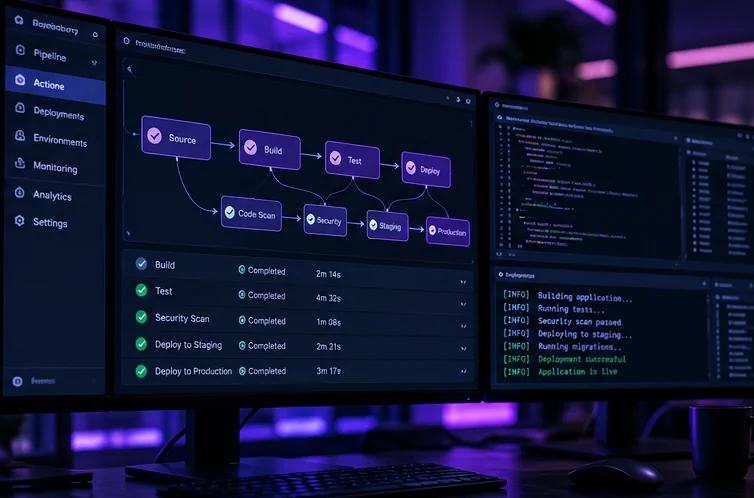
Releases should be predictable, repeatable and recoverable. We design CI/CD pipelines and deployment workflows that reduce manual steps and help teams ship changes with confidence.
From a single Node.js application to a containerized stack, practical automation makes development less fragile and production easier to understand.
Automated checks and deployments reduce forgotten steps, improve consistency and free developers to focus on delivering features.
Focused on the outcomes your company needs—not another box-checking feature list.
Automated builds, tests, linting and quality gates with readable feedback for every change.
Deployment workflows, environment separation, release approvals and rollback strategies appropriate for your hosting.
Docker workflows, repeatable configuration, server provisioning and infrastructure-as-code where it adds value.
Help with failed builds, process managers, server logs, health checks, metrics and deployment reliability.
Releasing software should be a repeatable process, not a tense manual ritual that depends on one person remembering every step. We help teams move from local builds and ad hoc server changes to tested, observable deployment workflows. That may include GitHub Actions pipelines, automated checks, Docker images, environment configuration, secrets management and reliable rollback procedures. We begin with your actual release process and identify where failures, delays or inconsistent environments occur. Then we automate the high-value steps without adding orchestration complexity your team does not need. A small application may be better served by a straightforward deployment pipeline than by a large Kubernetes environment. We also look at how builds are reproduced, how incidents are investigated and how access is controlled. Good DevOps practices reduce the time between making a change and knowing it is safe to ship. The result is less firefighting, a better developer experience and deployments that are documented, predictable and maintainable when your team or hosting requirements grow.
Let's plan your project ↗From established platforms to modern development stacks, the best fit depends on how your team works and where you want to go.
 GitHub Actions
 Jenkins
 Docker
 Podman
 Terraform
 Ansible
 Linux
 Nginx
 AWS
 Azure
 Google Cloud
Platform marks load from a public icon library when available. Platform names remain visible regardless.
Review the repository, hosting and deployment risks
Document build and environment requirements
Automate testing, packaging and deployment
Validate rollback, secrets and operational checks
Hand off a maintainable release playbook
Even a small team benefits from repeatable builds and deployment checks. The solution can stay lightweight—often a well-configured GitHub Actions workflow is sufficient.
Not necessarily. A straightforward application may be better served by a managed service, VM or Docker Compose. Complexity should be justified by scale and operational requirements.
Yes. Dependency compatibility, Node.js versions, system libraries, environment variables and hosting-specific configuration are common areas to investigate.